
Plant 4 India currently operates from 4 project sites. After training in Sadhana Forest, Auroville, for one month, you will be sent to serve at one of these sites. In each of these sites, Fellows plant indigenous, food-bearing trees together with the local community, implement water conservation measures and provide training in the same.
The centers are off-grid, solar powered and house a team of 3 to 4 Fellows each. The centers are solar powered, do not use any chemical products and aim at zero waste.
The training center in Garo Hills

Meghalaya
Land restoration training in one of the Immersion Centers. Planting leguminous cover crops to fix nitrogen in the soil

Plant 4 India runs 3 ‘Immersion Centers’ located in rural villages in Meghalaya. Each center is located in one of Meghalaya’s three tribal regions: Khasi, Garo and Jaintia. These centers are supported by the Meghalaya State Government, Government of India and World Bank under Meghalaya’s Community-Led Landschap Management Project (CLLMP).
The issues faced by the local people are deforestation, erosion, environmental degradation and lack of access to water. Even though Meghalaya is the rainiest place on earth, many people still do not have easy access to safe drinking water. Because of intensive deforestation for mining and agricultural purposes, there has been a lot of erosion. These areas are very hilly, and when there is no forest to cover the hills, the water just rushes down the hill during monsoon periods, causing flooding in lower lying areas such as Bangladesh.
A-frame training. Creating an A-frame to dig on-contour swales

The Plant 4 India Immersion Centers offer daily trainings to the people of Meghalaya in simple and cost-effective ecological regeneration techniques and watershed management. You can find more information about the trainings and the techniques applied here.
One of the most commonly applied regeneration techniques are swales. Swales are on-contour trenches that are dug on sloped lands to prevent water run-off and erosion and make rainwater sink into the soil. A trench is dug that is fully level (‘on-contour’). With the soil that is dug up, a bund is created on the downhill side of the swale. As the swale is fully level, the water that is collected when it rains, stops flowing and percolates down into the soil. The bund prevents the swale from overflowing. On the bund, at first leguminous cover crops are planted that will fix nitrogen in the soil. The legumes are chopped and dropped before they flower to keep the nitrogen in the soil. Afterwards, indigenous trees are planted on the bund. These trees will keep the soil of the bund together and benefit from the water collected by the trench. In this way, swales enable fast regeneration of sloped lands that are suffering from erosion.
The effect of a swale over a 5 year period in Sadhana Forest.


These off-grid sustainable centers are built using refurbished second hand buses and house a team of 3-4 Fellows. Each center has 3 buses that are fully stationary and serve as classrooms, dormitory, bathroom and kitchen.
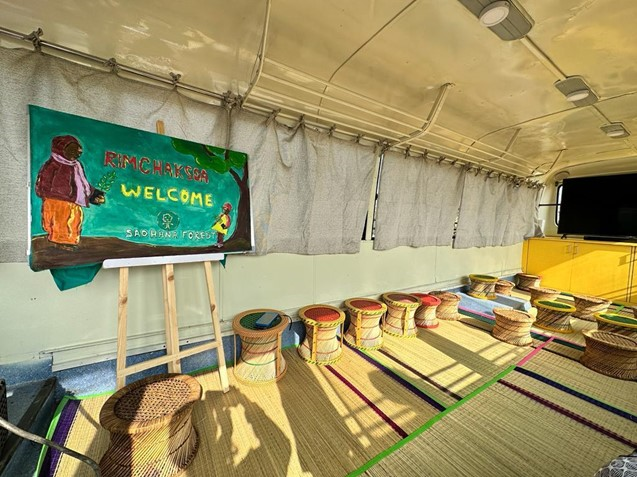
Training bus in Garo Hills
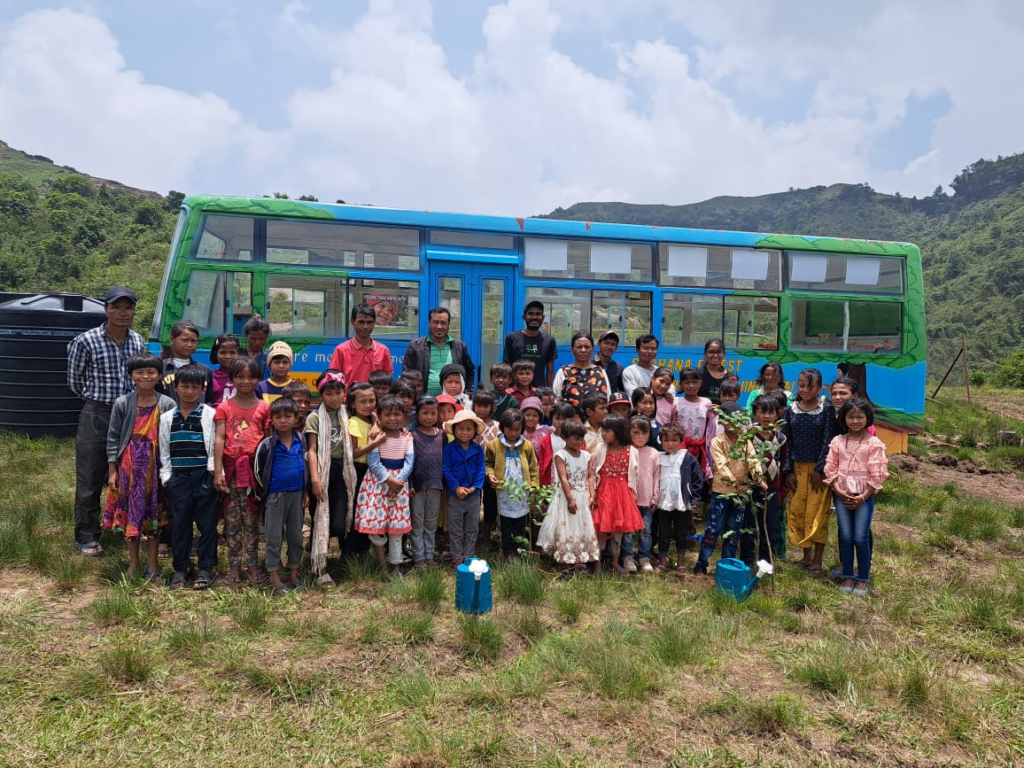
Welcoming a group of children in Khasi Hills
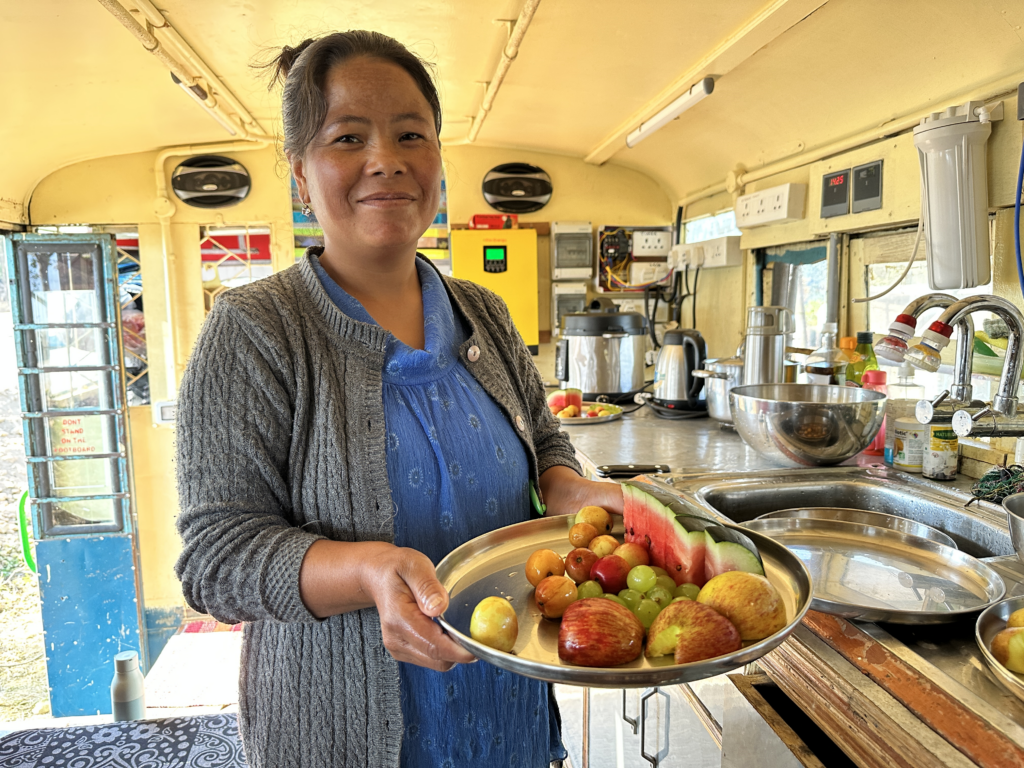
Kitchen area in Garo Hills
Tamil Nadu
In the south of Tamil Nadu, in Virudhunagar District, Plant 4 India runs a Mobile Reforestation Center, focused on planting food-bearing trees with Dalit communities.
The area south of the city of Madurai is very dry and has been almost entirely deforested. Because of climate change, already scarce rainfall is becoming more and more irregular. It is becoming increasingly difficult for local communities to sustain themselves through rainfed agriculture. Many houses in the villages here lie abandoned as people move to city slums. Those that cannot afford to relocate stay behind and are desperate for solutions.
Tree planting in Virudhunagar District

By planting indigenous, drought-resistant, food-bearing trees with these rural communities, we are regenerating their lands, providing them with much needed climate change mitigation and at the same time with nutritious fruits, nuts and leaves, which they have very limited access to. The local people are eager to plant these trees to give them shade, fresh air, and a much need compliment to their diet which consists mainly of staple foods.
The Plant 4 India Mobile Reforestation Center consists of a refurbished 60-seater bus that serves as a kitchen, dormitory, bathroom, toolshed and is fitted with a water tank and solar panels. The bus is semi-permanently stationed in of the villages and we retain very good relationships with our neighbors.
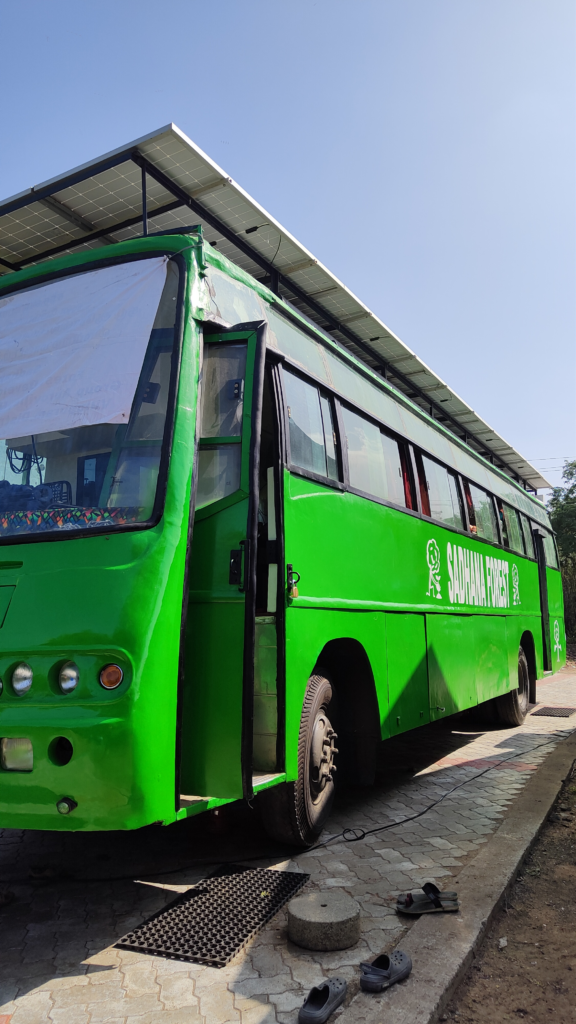
The bus in Virudhunagar District
For more photos, go to our gallery.